
The Cobra rings again
The phone that was built to last fifty years can dial grandma again. The Barnluren adapter now understands the rotary dial, so Dialog, Cobra and Diavox phones work as a child's own phone. Here are the phones, country by country, and what it takes.
By Barnluren
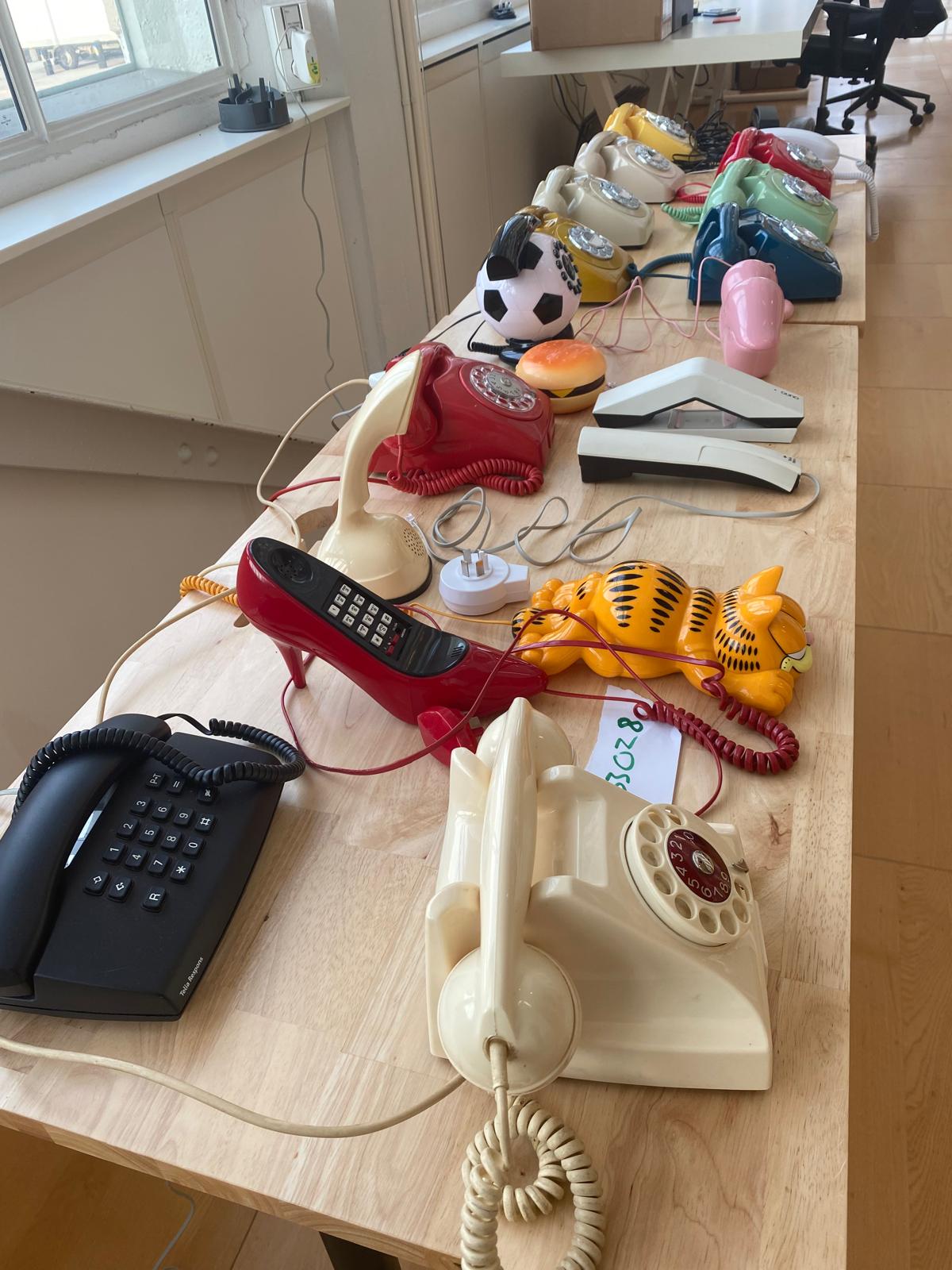
The office table in September 2026. Cobra, Telia Respons, Garfield, a shoe, a hamburger, a football and GPO 746s in six colours. All of them ring. Photo: Barnluren.
There is a telephone in almost every Swedish basement. Grey, orange or green, with a rotary dial that makes a sound nobody who has heard it forgets. It was built to last fifty years, and it has. The problem has been that nobody could use it.
Now they can. The Barnluren adapter understands the rotary dial, which means most old phones can be plugged in as a child's own phone, with nothing to set up.
Why the dial was hard
A push-button phone sends a tone for each digit. A rotary dial sends pulses: a number of short breaks in the line, one for each step the dial turns back. That sounds simple, but there is a catch. Countries counted differently. An international phone sends as many pulses as the digit. A Swedish phone sends one extra, so a seven becomes eight pulses. New Zealand counted backwards.
So the adapter needs to know which country the phone comes from, and it does not. The solution was to let it listen. Every Barnluren number starts with seven, and seven gives a different pulse count in each system. The first digit therefore reveals the convention, and the rest of the number is read accordingly. The child lifts the handset, dials, and it rings. No setting, no app.
What does not work yet: the dial can only reach Barnluren numbers. Ordinary phone numbers, which arrive with the Barnluren Everyone plan, need a different decoder that is designed but not built. We say so, so nobody is surprised.
The phones
We have plugged these in ourselves, or know they work. The rule is simple: an analogue corded phone, tone or rotary. Most phones built after 1960 qualify, sometimes with an adapter plug.
Ericofon, the Cobra (1956). Ericsson's one-piece phone, the first in the world with the handset and dial in one body. The dial sits underneath; you lift the whole phone and dial. It stands in the Museum of Modern Art in New York and in thousands of Swedish homes. Rotary, Swedish pulse convention, works.
Dialog (1962). The Swedish standard phone. Ericsson began making it in 1962, Televerket in 1964, and it sat in nearly every home into the 1990s. Light, easy to open, made so anyone could replace its parts. Grey was the most common, but it came in a dozen colours. From 1969 it was also made with a keypad. Rotary or tone, works.
Diavox (1978). Televerket's first phone built only for buttons, launched with the digital exchanges. Four million were made, three million with tone dialling. It is the easiest to connect: tone dialling and often the right plug already.
Telia Respons. The last generation of Telia phones before the fixed network began to come down. Rotary or buttons depending on the model. Works; it was a Respons we tested the Swedish pulse convention on.
GPO 746 (1967). Britain's answer to the Dialog, made in the millions for the British Post Office. It is the one we sell in the shop in mustard, green, ivory and azure blue, in a newly made version with tone dialling. A genuine one works too.
Kirk F68, Denmark. The Danish standard phone from KTAS, made by Kristian Kirks Telefonfabrikker under licence from Ericsson. It is a Dialog in Danish dress, and it works like one.
Heraldo (1963), Spain. Telefónica's phone for thirty years, made by Citesa in Málaga to a German ITT design. Grey at first, then in every colour. Rotary on the early ones, buttons on the later. Works with the right plug.
Finland in practice had the same phone as Sweden: the Dialog stood in nearly every Finnish home. The same rules apply.
The plug
Here is the catch for the Swedish phones. Until the 1990s Swedish phones had Televerket's own four-pin plug, not the small clear RJ11 plug the adapter uses. An adapter between the two can be bought in any electronics shop for a few kronor, and once it is in place the phone is ready. Danish, Spanish and British phones have their own versions of the same problem, and the same solution.
How the phone gets a new life
Two routes. Whoever has the phone plugs it in: the adapter costs SEK 499, the basic plan is included, and the child calls other Barnluren phones for free from day one. Whoever has no phone, or has one and no child to give it to, goes through the Loop: send the phone in with free shipping, we test and clean it and let it ring again in a child's home. Until 13 October we are also giving away a genuine Garfield phone among everyone who enters.
The phone in the basement was not built to stand there. It was built for someone to answer.