
The smartwatch answers the parent's need. The phone answers the child's.
Wearable trackers and home phones look like one product category. They are opposite interventions in a child's development.
By Greg Chrystall
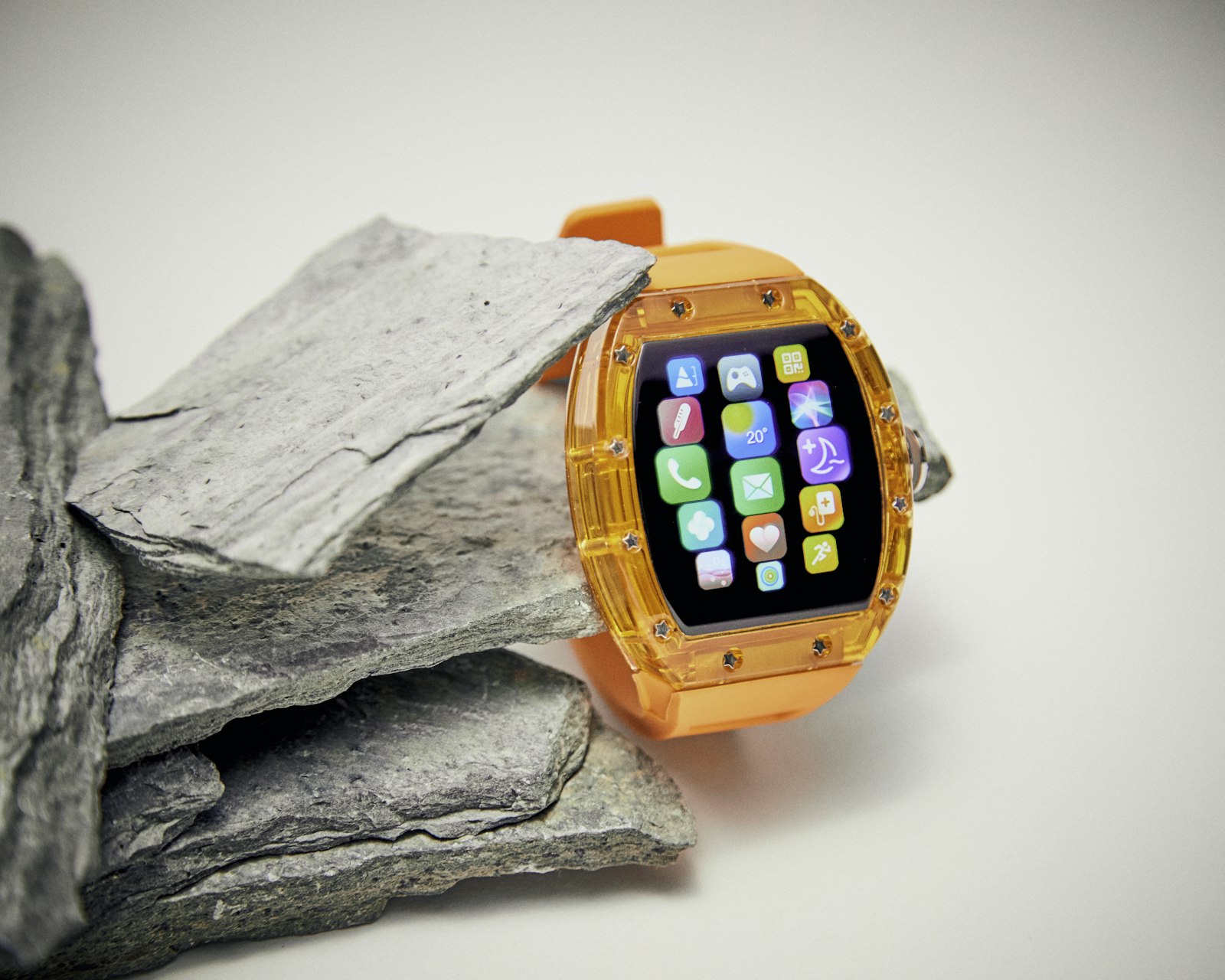
Photo: Gourmet Lenz / Unsplash
In 2002, 95% of households in Sweden had a fixed landline phone, which was usually available to everyone who lived there, including children. By 2024 only 6% of households had a landline phone. Adults understandably cut the cables when mobile phones made the landline redundant. Why pay hundreds of euros per year for a device that only rings when a telemarketer or scammer calls? A rational decision for the adults. But this created a gap for children: they lost their only direct line to other households. All of a child's communication is brokered through a parent's mobile phone, which very quickly turned into a smartphone.
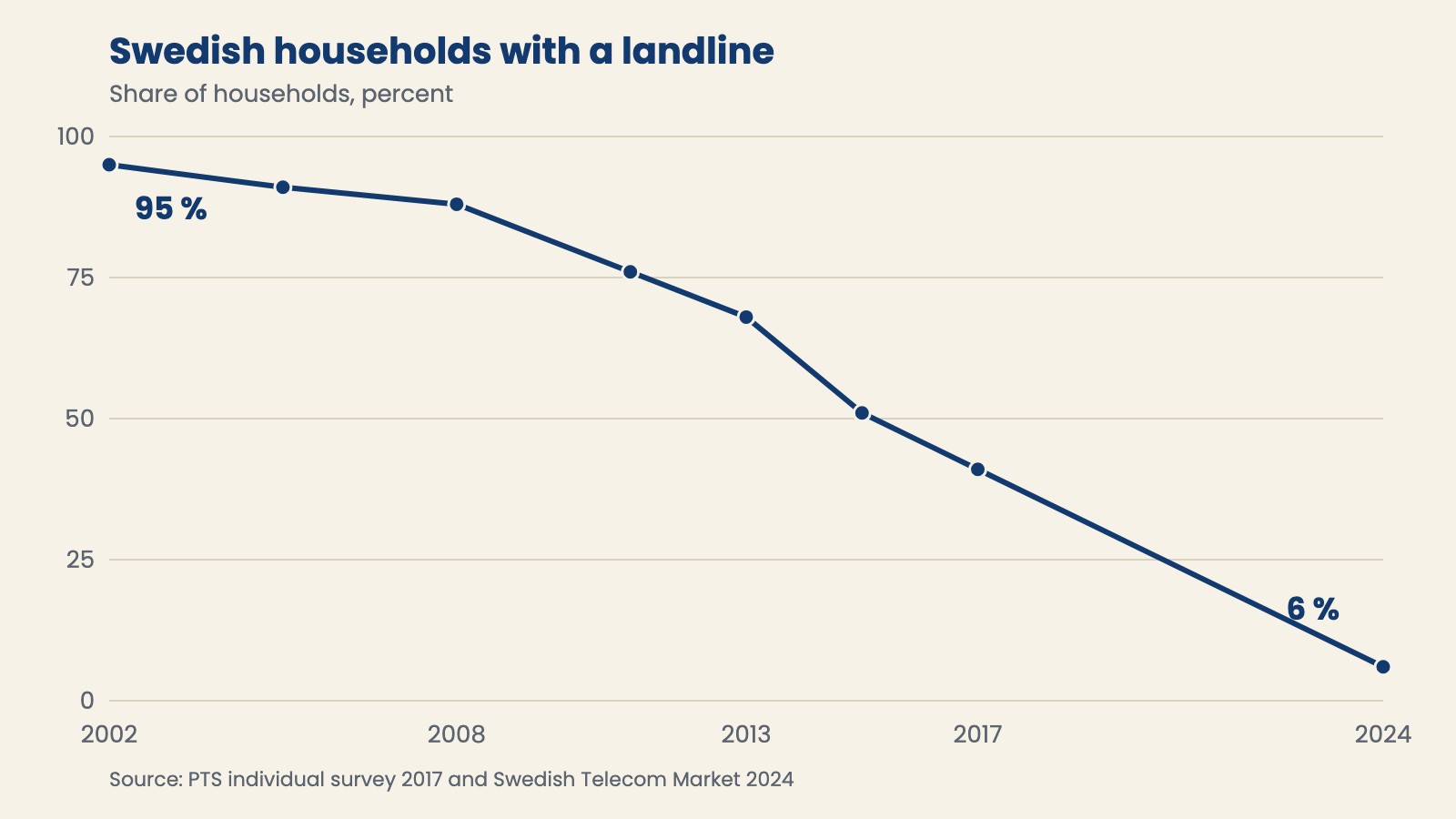
Share of Swedish households with a landline, 2002 to 2024. Source: PTS.
As parents noticed this gap, they started to give their children smartphones much earlier. By 2022, 82% of 9-year-olds in Sweden had a smartphone. Parents have now concluded that this backfired; the decline in mental health is real and agreed. Anxiety among young people has increased. The smartphone ownership rate for 9-year-olds dropped to 67% in two years, and a strong screen-free movement has formed across Europe and the US.
Unfortunately, the correction has re-introduced the isolation: a child's communication is once again brokered through a parent's smartphone. And it comes at a moment when the case for relationships has never been stronger. Loneliness is now treated as a serious public-health issue: the US Surgeon General's 2023 advisory was titled Our Epidemic of Loneliness and Isolation, and it notes that time spent in person with friends among 15–24-year-olds fell by nearly 70% between 2003 and 2020. Relationships are not just nice to have; a large meta-analysis found that people with stronger social relationships had a 50% higher likelihood of survival, an effect the authors compare with well-established risk factors like smoking.
The ages between 4 and 10 are when some of the key skills that support those relationships are built: conversational repair, topic maintenance, turn timing. Conversation is also a central mechanism of friendship formation in children: the classic observational study of how children become friends found it ran through exactly these conversational processes.
A phone conversation is itself a skill, not an instinct. The one field study of families with children this age using the telephone found most children can't hold a call on their own before seven or eight; younger children need an adult nearby, prompting. I learned this at home before I read it. My daughter got her own phone at eight and, to my surprise, could not hold a conversation at all. We prompted constantly: ask a question. Remember what grandma told you last time, and ask how it went. Tell her something you did this week. She picked it up fast. Today she is deep into 55-minute calls, unsupervised. But I wish I had realised earlier that this was a skill I could have helped her build years sooner. This is one child, my child, and we sell the phone she learned on, so weigh it accordingly. But it matches the research: the skill responds quickly to practice, and the practice has to happen somewhere.
Parents understand the stakes, and one very popular solution has been the smartwatch. To a parent, a smartwatch is very appealing: it allows you to track your child's location, reach them with voice and messages, and know that they can always call you. It answers the parent's need: where is my child, and can I reach them? It just doesn't meet the child's need: how do I reach my friend? We sell a different product, a landline phone specifically for children, so read this article with that in mind.
When choosing a communication device for children, a voice-only phone may appear to be in the same category as the smartwatch. Both are alternatives to the smartphone. We see them as very separate interventions with different purposes and outcomes for child development. A smartwatch is a vertical channel. It tends to run parent to child. It is always reporting its location, worn on the body, following the child everywhere they go. It extends the parental presence into the child's independent world. Holding longer conversations on a smartwatch is not very practical. Parents tend to choose a smartwatch as a safety device.
A phone designed for voice calls, on the other hand, is a horizontal device. Household to household, child to child, or child to a relative and vice versa. Either side can initiate; no location data, no association with tracking; fixed in place in the home. A voice-only phone extends the child's own social reach. Being called matters just as much as calling someone: the phone ringing means someone wanted you, not to check up on you or know where you are, but simply to reach out and talk to you. Both directions are important for social development: learning to initiate contact and take responsibility for your social life, and receiving that contact from others and learning to respond. Children do this naturally in person. Unfortunately, children are no longer free to roam for most of their free time. In Sweden, the share of parents who let their 7–9-year-olds walk to school alone fell from 94% in 1981 to 46% in 2012. Living in cities where safety is a concern is a major contributor, and another factor in the appeal of the smartwatch.
As a consequence, children end up spending far more time alone, usually with a screen. And yes, children also socialize through screens. But the research on shared screen activities finds the benefit comes from the interaction, not the screen: children who played the same game cooperatively behaved more prosocially afterwards than children who played it alone. When the talking stops, the benefit stops. A voice call is the talking, with everything else removed.
A simple phone gives children both: the friendship-building and the agency. Children want to initiate contact, but a child who has never had the ability doesn't know it's missing. Planning playdates became a parent's responsibility simply because children were cut off. Before my daughter could call her friends, she never once initiated one; plans were made over her head, parent to parent. Now she calls a friend and asks, the two of them make a plan, and each negotiates with their own parents. That is far easier, as any parent will recognise, than parents brokering with parents. On a Saturday morning it means something simpler still: do you want to meet at the park? In our experience the phone is not a substitute for being together; it is the logistics layer for it. Whether that holds beyond the families we hear from is a study nobody has yet run. We are describing what we see, and calling it a hypothesis.
Smartwatches and voice-only phones play very different roles: the vertical channel serves the need for logistics and reassurance. The argument here is not that one is bad and the other good; it is simply that they answer different needs, and only one of those needs is about the child's development.
We have over a century of familiarity with the voice-only phone, a device with no feed, no metrics, and no attention economics. It's a known quantity. There is not yet concrete data on smartwatches; surveys show that 29% of Norwegian 9–10-year-olds have one. Sweden has not reported any numbers. Mediemyndigheten does not ask the question. The flagship survey has not caught up with a device this many parents are reaching for.
Barnluren is deliberately screen-free for children (and for adults, if they choose). Our mission is simply to improve childhood, and we believe, based on our own experience, that for the age range where a smartphone is being avoided, a voice-only phone is the best communication channel.
Barnluren is a small Swedish startup making a bet on the horizontal channel, and we are early. We don't yet know whether children keep calling once the novelty wears off, whether a home phone displaces the smartphone or merely delays it, or whether these arguments survive contact with real data. The honest answer is that almost nobody has studied this space, not the watch and not the phone. That is worth fixing. If you research children's communication, independence or media use, or you are a parent who thinks we have this wrong, we would like to hear from you: [email protected]. The smartwatch answers the parent's need. The child's need deserves an answer too.